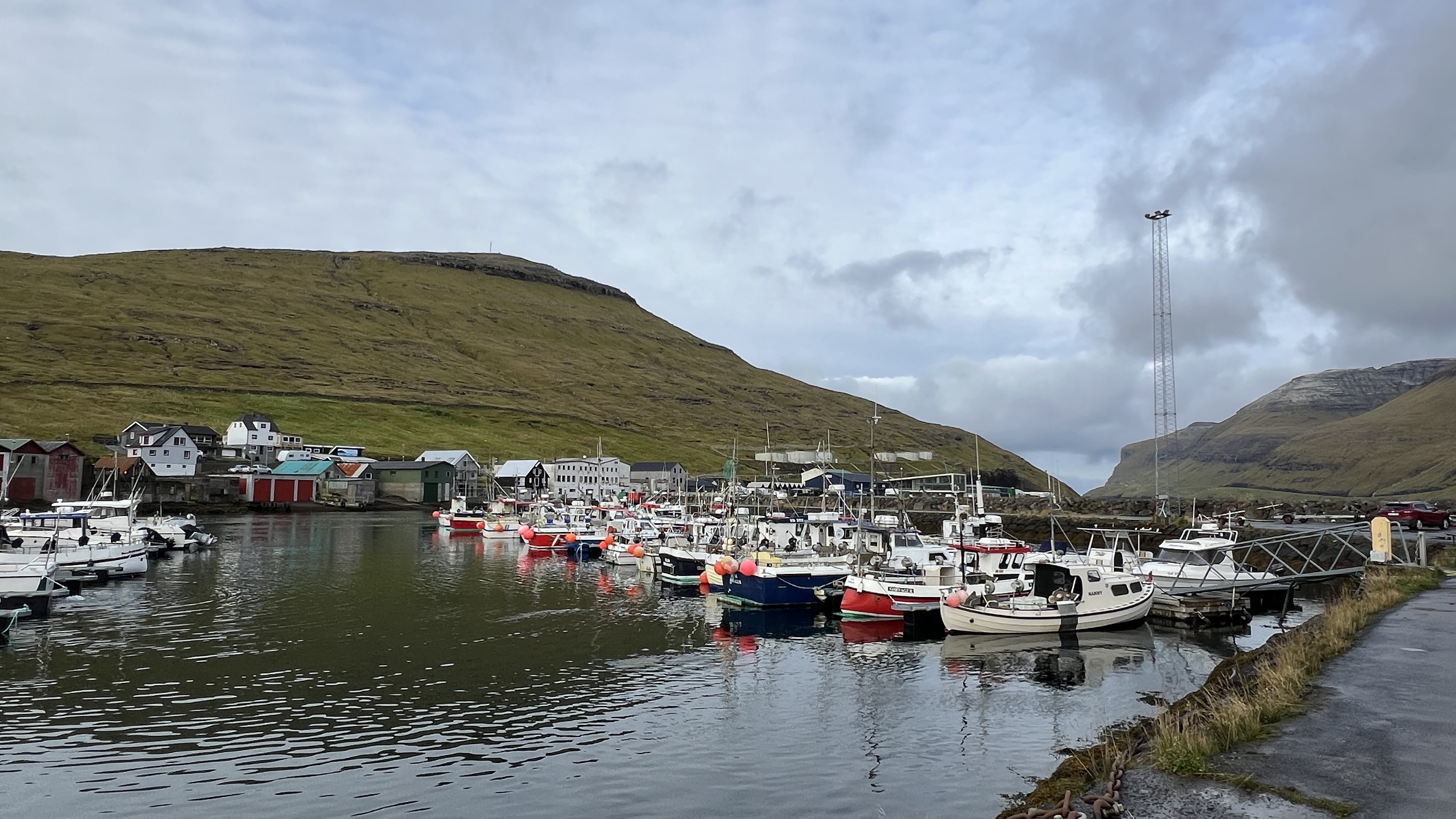
Today we planned to visit two islands - Streymoy and Eysturoy. The morning was a little drizzly but that failed to dampen our mood. Because of the overnight rain, the mountains, which surrounded us as we drove, were fringed with curtains of waterfalls sending megalitres of water barrelling down the slopes. The land must be almost constantly saturated. It was quite magnificent.
 |
| After any rain the escarpment was awash with waterfalls |
Today we drove, via a sea tunnel over 5km long, to explore another island, the island of Streymoy, before driving on to the island of Eysturoy via a bridge, fortunately! There, we were to stay at Gjogv.
 |
| The Saga Museum is housed in the Vestmanna Tourist centre |
We were heading for Vestmanna to visit the Saga Museum which also promised a hearty bowl of fish soup (Vestmanna means ‘man from the west’ which in this case were Irish monks who came seeking solitude to worship). The museum was rather like a walk through history. The fish soup was going to cost us about $30 a bowl so we opted out and headed back into the rain and on to a small village, Kvivik, which huddles on either side of the River Stora. Here, archaeologists have found the remains of a Viking settlement. Unfortunately the rain prevented us getting out for a proper look at some places – it was simply too wet and often rather slippery.
 |
| There is a memorial in this graveyard to the Vikings |
We took a fortuitous detour and discovered a wonderful waterfall and a wee village with a gorgeous little turf-roofed church. All the while, it was raining which blurred the scenery somewhat but we were still able to see and enjoy its beauty.
 |
| Quaint turf-roofed church at Kaldbak |
 |
| Tyggjara waterfall |
 |
| The sound of the roaring waterfall was deafening |
 |
| Tyggjara waterfall from across the water on Eysturoy |
Then it was time to make our way to our night’s accommodation which was in Gjogv, the most northern village on this island. It is named for the long deep, sea-filled gorge around which the village crouches. It took us two attempts before we were game to tackle the road which, because of the approaching winter weather, claimed to be closed to all but local and rescue vehicles.
 |
| This was the turn off to reach our village through the mountains |
 |
| Our second attempt we read the sign properly - another day before it would be closed! |
We later discovered that closure didn’t come into effect for another day – phew! we were safe – sort of! The trip over the mountains to reach wee isolated Gjogv was pretty hair-raising but ultimately we got there albeit nervous wrecks as the road was wet, foggy in parts and extremely narrow. I can understand why it is closed to general traffic during winter.
On our way over the mountains, we passed a turn off to a ‘road’ that zig zagged down a long deep valley to the sea. That wasn’t our road thankfully and so I was breathing a sigh of relief - at the time! Little did I know then that we would have to travel that self-same road a couple of times the next day. You have to remember that this was only our second day of driving Faroe’s roads (most of which masquerade as tracks!). A day driving in and out of rain on often challenging roads but what an ending!
Our B&B was perched on the side of a hill with spectacular views of the sea and surrounding mountains. For the time we were safe in our little eyrie surrounded by thick lush vegetation which I imagined would be a glorious profusion of flowers in spring. It was lovely and we were safe! We dined-in that night as we needed something more than a ‘picnic’ - food is pretty expensive here as most of it has to be imported.
 |
| Our room was just up the slope and it definitely was a room with a view! |
 |
| Glorious |
 |
| Up close, the turf roofs are interesting. It would be stunning if there are flowers amongst that. |